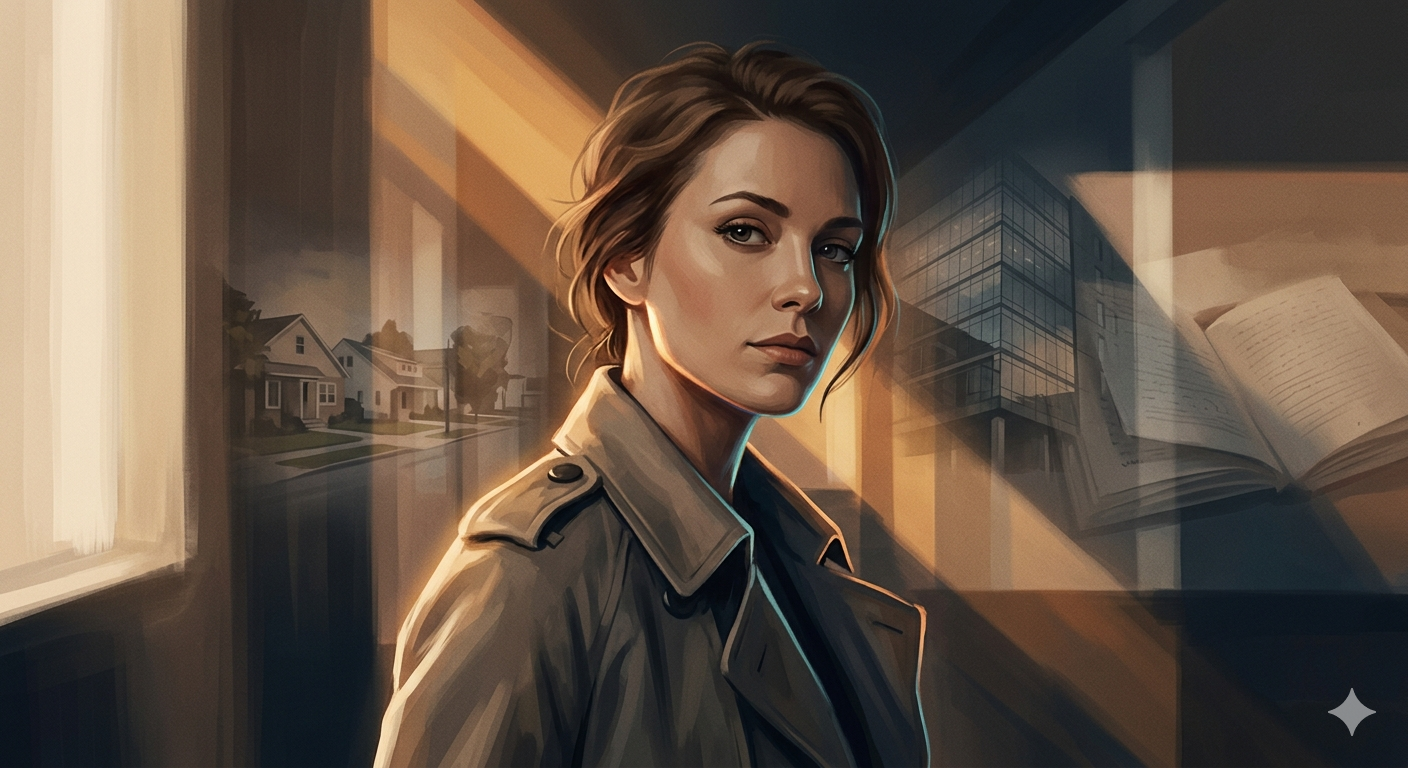
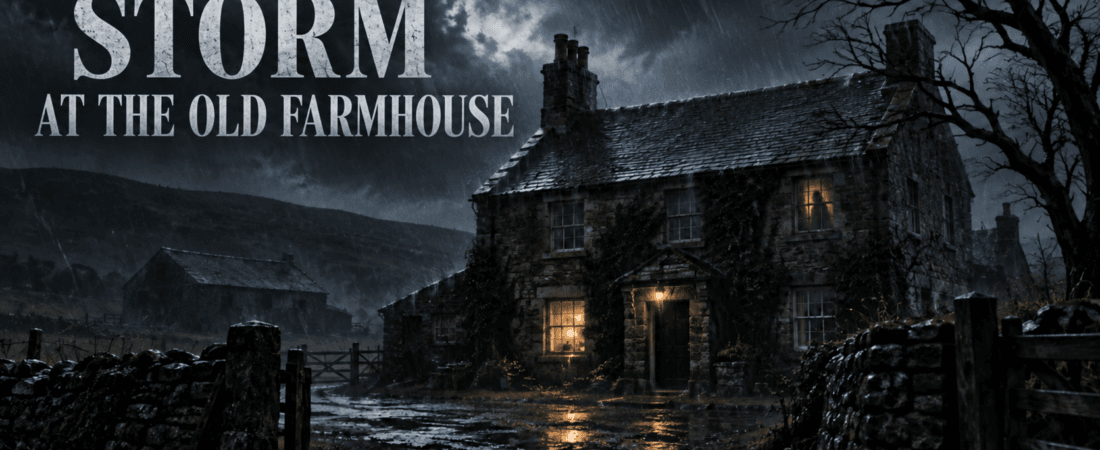
The storm came over the hills just after dusk and turned the windows into mirrors, so that when Mara looked out she saw only her own kitchen looking back at her.
She had lit the lamp early. The electricity had been failing all week, and in weather like this it was a question of when, not whether. On the stove the kettle made a thin, nervous rattle.
Daniel stood at the back door with one hand on the latch, staring into the rain as though he could see through it.
«You’re not going out in that,» she said.
«I’ll check the barn shutters.»
«In this?»
He gave her the short, tired smile he had been giving her for three weeks. «The horses spook if one comes loose.»
«We don’t have horses.»
«Old habit.»
It was one of the things she had loved in him from the start, and lately one of the things that frightened her: the way he could put a joke in front of a thing to stop you looking at it.
The farmhouse had belonged to the Mercer family for more than eighty years before they bought it. It had sold fast, and cheap, cheap enough that Mara had spent a fortnight looking for the flaw — subsidence, radon, a road scheme. The estate agent had said only that the family had had their reasons, in a tone that closed the subject, and in the country you learned not to ask a question twice.
Daniel had loved the house at once. Mara had come to it more slowly. She liked the orchard and the long slant of the fields and the silence. She had never liked the room at the end of the upstairs passage, which was locked and had no key, or the patch in the stairwell wall where the plaster had been made good in a rectangle that did not match anything around it.
Old houses have secrets, Daniel had said. Draughts and grudges and buried cutlery and the names of people nobody mentions.
That had satisfied her for three years.
It had stopped satisfying her three weeks ago, when he began burning rubbish in the barn stove at night.
He had an explanation for that too. There was a century of junk in the outbuildings; he was clearing it; he liked the work. Twice a week he carried the ash out in a galvanised bucket and spread it under the apple trees, because wood ash was good for fruit, which was true. She had decided it was a hobby. A man of forty-one who could not sit still, finally sitting still in his own way.
His coat smelled of smoke now, always, even after washing. She had stopped mentioning it.
The wind struck the side of the house hard enough to move the copper pans on their hooks. Mara set down the mug she was drying.
«Tell me you’re not in one of your moods.»
«What mood?»
«The one where you look at walls as though they’ve said something to you.»
«I don’t look at walls.»
«You do if I say you do.»
He almost laughed. And then they both heard it, under the rain — a metallic scrape, the yard gate going over, and a cry cut short by the wind.
Daniel was at the door before she had turned round.
«Stay here.»
«Absolutely not.»
«You won’t be any help.»
«I’m not planning to be helpful. I’m planning to be loud, if somebody is dying in our yard.»
He opened the door and the storm came into the kitchen in one wet, freezing breath. Beyond the porch light the yard was a smear of rain and thrashing branches. Daniel took the torch off its hook and swept the beam across the dark.
A man was getting up out of the mud by the gate.
He had one hand pressed to the side of his head and the other wrapped round the handle of a small suitcase — too small for anyone to have travelled far with, and held too tightly to be put down. Thirty-five, perhaps forty. Tall, narrow through the shoulders, dark hair flat to his forehead, a coat so wet it had lost its shape.
He lifted a hand. Not a greeting. The gesture of a man who expects to be refused.
«Please. My car went off the road. I saw your light.»
The road was the better part of a mile down the hill, and tonight it was mud to the axles.
Mara had come to the doorway behind Daniel, holding her cardigan closed at the throat. «We should ring for help.»
«Phone’s dead.» His voice was rough with rain and something else. «I know what I’m asking. I’ve been walking an hour.»
The wind screamed through the porch posts. The man shivered, hard, and it looked real.
«Come in,» Mara said.
Daniel did not move for a moment. Then he stood aside.
The stranger came up the steps and nearly went down again on the wet boards, and Daniel caught his elbow. Close to, he smelled of wet wool and mud and old smoke.
«Thank you.» His eyes went from Mara to Daniel and back, and what was in them was not gratitude and not quite relief. It was the look of a man checking two faces against something he had studied.
That was the first thing that was wrong.
The second was the way he read the kitchen — the hallway, the turn of the stairs — in three quick movements, the way a man looks at rooms he has already been told about.
Daniel saw it. Mara knew by the small tightening at the corner of his mouth.
«We’ll get you dry,» Daniel said.
«I appreciate it.»
«What’s your name?»
He hesitated. It was very short, but it was there.
«Elias.»
It came out the way a line comes out when it has been said aloud in a car, alone, several times.
Daniel took the suitcase from his hand. It was heavier than it looked. The man watched it go with the flat, reflexive attention of someone watching a stranger pick up his bones.
«Sit by the stove,» Mara said. «I’ll make tea.»
He did not sit. He looked past her into the hall again, and a line came and went between his brows.
«You’ve changed the wallpaper,» he said.
Mara stopped with the caddy in her hand.
Daniel turned his head slowly. «Sorry?»
The man blinked, like someone who has heard his own voice a half-second late. «Nothing. I was thinking of another house.»
«Have you been here before?» Mara asked.
«No.»
He had answered too quickly, and the kitchen seemed to draw in around the three of them.
She made herself move. Towels, kettle, the tin of plasters from the dresser drawer. Daniel put the suitcase down by the door and stayed near it, as though it might get up.
The man got his coat off with difficulty and hung it over a chair, and water ran off it onto the flags. He had a split lip, a bruise coming up at the temple, and two buttons torn clean out of his shirt, taking the cloth with them.
Daniel saw all three.
«Car accident?»
«I swerved for something in the road. A deer, I think.» A pause of exactly the wrong length. «It might have been a person. Hard to say, in that.»
«A person.»
«It was gone by the time I got out.»
Mara came back with the towels. «You want a doctor, if your head’s bleeding.»
«It’s nothing.»
«Let me decide that.»
He sat when she told him to. When she bent to look at the cut on his temple his eyes moved over her face with the same terrible concentration, and she had to steady her hands.
«Do you live here alone?» he asked.
«Together,» Daniel said, from behind them.
The man looked up at him. «Of course.»
He said it as though he had been expecting a different answer, and had just learned something from not getting it.
Mara wound gauze around his head. «How do you know this road?»
«I don’t.»
«But you saw the house from the main road.»
«I saw a light through the trees.»
«That doesn’t tell me how you knew to come round to the kitchen.»
His expression did not move. «I don’t know where the kitchen is. I followed the passage because the front room was dark.»
Daniel folded his arms. «You seem very sure of the layout, for a man who’s never been inside.»
«I’ve been inside houses like this.»
«That isn’t the same thing.»
«No,» he agreed, and there was something in the word that put the cold straight through her.
The rain came down harder. Somewhere in the roof a pipe ticked as it cooled and then settled.
Mara wanted the conversation to die. He would not let it.
«You’ve been here long?» he asked Daniel.
«Long enough.»
«Interesting.»
Daniel laughed once, without any humour in it. «Is it?»
The man let that go. «Your wife said the people before you were called Mercer.»
Mara looked up. «I didn’t say that.»
«No,» he said. «You didn’t.»
The kitchen went completely still. Then the kettle began to whistle, and she was grateful for the excuse to turn her back on both of them.
When she turned round again his eyes had gone past her, up the stairs, to the landing you could just see through the half-open door.
«There used to be a room at the end of that passage,» he said.
Daniel’s face changed. Only a little. Mara had lived with that face for six years and she saw it.
«You’re either extremely observant,» Daniel said, «or you’re playing a game.»
The man finally drank some of the tea and made a face at it.
«It’s tea,» Mara said.
«It tastes like something you make to stop yourself crying.»
Daniel put both hands on the back of a chair. «Who are you?»
For a long moment the man only looked at him. Then he reached into his coat and brought out a folded envelope, thick, soft at the edges from handling, and set it on the table without letting go of it.
«I came because of the house.»
«Meaning what?»
His eyes flicked to the patched rectangle in the stairwell wall and came back to Mara’s face.
«Meaning one of you isn’t who the records say you are,» he said. «And meaning there is something in your walls that was never supposed to be found.»
Daniel laughed again, and this time it was thin and hard.
«You come into my house in a storm and accuse us of fraud.»
«I didn’t come in. I was let in.»
«You were in the road.»
The man sat back a fraction. «I’m here because my father owned this house.»
Neither of them spoke.
«Mercer sold this place to us,» Daniel said at last.
«Yes.»
«So?»
The man looked from one of them to the other, and his face was unreadable, and almost sorry.
«My father was Martin Mercer.»
Mara had heard the name once, from the estate agent, and never again after.
Daniel had gone very still.
«He disappeared when I was eleven,» the man said.
The kettle shrieked and Mara pulled it off the ring with too much force.
«Disappeared,» Daniel repeated.
«The official version is that he walked out. The family accepted it, the police found nothing, and my mother sold the property years later, after it had sat empty long enough for the talk to get unbearable.»
Mara folded her hands together to stop them. «Why are you telling us this?»
«Because he didn’t walk out,» the man said. «And because when I was old enough to understand what had happened, I found what he’d hidden.»
Daniel’s eyes narrowed. «If this is about money—»
«It isn’t.»
«Then what is it about?»
He looked at the wall again, and this time he did not trouble to hide it.
«A body,» he said. «Or what’s left of one.»
The word went through the room like a stone through glass.
«That’s mad,» Mara said.
«Is it?»
Daniel’s voice had gone flat. «Why come here, then? Why not the police?»
«And tell them what? That I’m the son of a man who went missing thirty-one years ago, and I’ve come to a farmhouse in the dark because of a rumour and a feeling?» He smiled slightly. «They were very kind to me the first two times.»
Mara felt a lurch of sympathy and, immediately behind it, suspicion. «What exactly did you find?»
He did not answer at once.
The storm pushed at the windows. Something knocked, faintly, in the roof or the chimney.
«I found where my father had been cutting into the wall,» he said.
Daniel’s face had gone the colour of the plaster.
Mara saw it.
«Cutting into which wall?» she said.
The man looked at her with something close to pity. «The room at the end of the passage.»
«There is no room at the end of the passage,» Daniel said.
Nothing changed in the stranger’s face. Something changed in the air.
«There was,» he said. «My father sealed it. I know, because I watched him do it.»
The silence afterwards was deep enough to hear the storm properly.
Mara turned to her husband. «You told me that end wall was old storage.»
«It is.»
«Daniel.»
He met her eyes, and what was in them was not surprise. It was recognition.
The stranger saw it too. «You know,» he said.
«You’re concussed.»
«No.»
«You’re trying to frighten us.»
«I’m trying to warn you.»
«Why should we believe a word of it?» Mara demanded.
He looked at her fully then. «Because whoever moved into this house after my father went was lying from the day they arrived. Because someone knew that wall was there. Because what’s inside it was meant to stay inside it, whoever came after.»
«There was nobody here before us,» Mara said.
He kept his eyes on Daniel. «Wasn’t there?»
Daniel said nothing.
Mara turned, slowly, to face her husband.
«Daniel?»
The lamp trembled in the polished wood. He opened his mouth.
And the house groaned above them.
All three of them looked up.
It was a footstep. Slow, deliberate, crossing the landing.
Mara’s heart gave one enormous beat against her ribs. «There’s someone up there.»
«No,» Daniel said, instantly.
The step came again.
The stranger stood so fast his chair went back across the flags. «How many people live in this house?»
«Just us.» She could not take her eyes off the ceiling.
Another step. Then a soft dragging scrape, as if something heavy were being pulled over boards.
Daniel was not looking at the ceiling. He was looking at the stairwell doorway, and there was no confusion in his face at all.
«Daniel,» Mara said. «What is in this house?»
He didn’t answer.
The stranger crossed the hall in three strides and took the torch off its hook.
«Don’t,» Daniel said.
He turned. «You know exactly what that is.»
«Put the light down.»
«Why?»
«Because if you go up there now you’ll make it worse.»
«Worse,» Mara repeated. «Worse than what?»
The scrape came again. Then it stopped, and the stopping was worse.
«Tell her,» the stranger said.
Daniel’s throat moved. When it finally came, it came all at once, like something he had been holding shut with his hands.
«The end room was never storage. When we moved in the wall was newly made good. Fresh nails, fresh lath, paint that hadn’t gone off. I thought somebody had tried to close a space that was already there.»
«And you never said.»
«I was working out what to do.»
«About a room.»
«About what’s in it.»
Mara heard her own voice go somewhere very far away. «Three years, Daniel.»
«Three weeks,» he said. «I opened it three weeks ago.»
She thought of the barn stove. Of the bucket. Of the ash going out under the apple trees in the dark, twice a week, for three weeks, while she stood at this window and thought: at least he’s found something to do.
Her legs went strange under her, and she put a hand on the table.
Then, from upstairs, the slow metal click of a lock being turned.
And three slow taps on wood.
Nobody moved.
The taps came again — three, patient, unhurried — and then the stairs began to take somebody’s weight, one tread at a time, badly, the way a man comes down stairs when something is wrong with his leg.
Mara backed against the dresser.
He came into the light holding the rail.
He was about fifty, grey through the beard, in a wet jacket with the sleeve torn from shoulder to elbow. His face was in a bad way: the eye socket swollen shut, blood dried black from the nose down over the mouth and re-wetted at the chin. He had been hit, several times, by somebody who knew how.
He looked at Mara first, and his good eye was steady and horribly calm.
«I’m sorry about your kitchen,» he said. «I’ve been in your roof space since Thursday.»
Then he looked at the man at the table.
«That is not my name,» he said. «That’s mine. Everything he’s told you is mine.»
Afterwards Mara could never get the next ten seconds into the right order.
The man at the table did not deny it. That was the thing she remembered. He put his hands flat on the wood, the way you do at the end of a long journey, and let out a breath, and said, «Sit down, Elias, before you fall down.»
«You broke my hand with a car door.»
«You wouldn’t stop.»
«Neither will you.»
«No.»
Mara heard herself say, stupidly, «Then who are you?»
«Adam Callow.» He said it without any drama at all, and it was worse for that. «My father was Ray Callow. He and Martin Mercer had a haulage business, out of Denwick, until 1994.»
Elias Mercer lowered himself onto the settle by the stove, slowly, holding his ribs.
«He told you he was eleven,» he said to Mara. «I was fifteen.»
And then he turned his ruined face to her husband, and said:
«Hello, Danny.»
The kitchen was very warm and very bright and Mara could not feel her hands.
«His name is Daniel,» she said.
«His name is Daniel Mercer,» Elias said. «He was ten. He’s my brother.»
She looked at Daniel. She wanted him to laugh, or to be angry, or to be anything at all. He was looking at the floor with the expression of a man who has put down a weight he has carried so long that he can no longer stand up straight without it.
«Say something.»
«Mara—»
«Say it isn’t true.»
«I can’t.»
The wind hit the house and somewhere upstairs a door she had never once heard move swung and knocked against its frame.
«Our mother took me away in the March,» Daniel said. «I was ten. She married Stephen when I was twelve and I took his name, and that is the name on everything I have ever signed, including our marriage certificate. It’s not a false name. It’s just not the first one.»
«You bought this house.»
«Yes.»
«You brought me to this house.»
«Yes.»
«Why?»
He looked up, and she saw that he had been going to lie, and that he had run out of the strength for it.
«Because the estate sold the top fields in 2019 and there was a planning application on the barns,» he said. «Surveys. A structural engineer in the roof and a damp man in the stairwell. Somebody was going to open that wall in the next ten years, and the only way to be certain it would be me was to own it.»
«And what,» Mara said, «is in the wall?»
Elias answered her, because Daniel could not.
«Our father,» he said.
He told it flatly, which made it bearable to hear, and unbearable to carry afterwards.
Martin Mercer had been a large, cheerful, well-liked man who was different in his own house. The end room had a bolt on the outside of the door for as long as either of them could remember. Elias had spent most of one winter in it, at thirteen, in stretches of two and three days. When Elias got big enough to be a problem, their father started putting Daniel in there instead.
In February 1994 Martin decided the room was more trouble than it was worth. He was going to close it up: brick the doorway, plaster over, put the passage cupboard where the door had been. He had the lime and the lath and the sand in the yard for a week. He worked at it in the evenings.
He put Daniel in the room on the Friday. He was still working with the door open, because he had not finished, and he had a temper on him that night, and Daniel was ten years old and had begun to scream in a way that Elias said he had never heard from a child before or since.
Elias hit him with the mattock from the yard.
Once, from behind, at the base of the skull. He had been fifteen, and big for it, and he had not planned any of it, and it was enough.
Their father’s own materials were stacked on the landing. It took the two of them the rest of that night and all of Saturday. Elias did the wall. Daniel carried the buckets, because he could not lift anything else, and because his brother would not let him leave the passage and be alone.
Their mother came back from her sister’s on the Sunday. She never asked one question about the new cupboard, or about the missing van keys, or about the mattock, which was in the pond. Two weeks later she told the police her husband had gone, and it was believed, because he owed money and because men do go.
«She knew,» Elias said. «She never once said so. She took him away in the March and left me here, because I was old enough not to say anything, and he wasn’t.»
He looked at the stove.
«I’ve been in a bed-and-breakfast in Denwick since the spring, waiting to see whether he’d do it. He did it three weeks ago. I’ve been in the roof since Thursday because he wanted me where his wife couldn’t see me and I wanted to be where I could see the wall.»
Adam Callow had not interrupted any of it. He sat with his hands still flat on the table, and when it was finished he pulled the soft envelope towards him.
«Now mine,» he said, «because it’s shorter.»
He put the papers out one at a time, the way a man does when he has laid them out for other people many times before and it has never once worked.
«When Martin Mercer went, four hundred and eleven thousand pounds went out of the company accounts over the eight months before it. My father was the other signature. Martin was gone and my father was here, so my father did it. He got six years and served four. The conviction turned on the money moving right up to the eleventh of March 1994, which put Martin alive and away and my father alone with the chequebook.»
He set down the last sheet and squared it with his thumb.
«He died in a rented room in Hull in 2011 still telling people it wasn’t him. If Martin Mercer died in this house in February 1994, then everything that moved after February is somebody forging a dead man, and my father’s conviction is rubbish, and I can have it looked at again. That’s all I want. I don’t want either of you. I want a coroner to look at what’s in that wall and put a date on it.»
Nobody said anything.
«You have to see,» Callow said, and for the first time his voice was not steady, «that I’m the only person in this kitchen asking for something reasonable.»
He was right. That was the thing Mara could not get round, then or later. Two men had killed their father in this house and had good reason, and everything they had done since was to keep a dead innocent man convicted, and none of them had chosen it and all of them were doing it.
«Then look,» Elias said.
Daniel said, «Eli.»
«Let him look.»
Callow took the torch and the crowbar from the porch and went up, and the rest of them went after him because there was nothing else left to do.
The passage smelled of cold plaster and burnt wood. The cupboard at the end had been pulled off the wall and stood in the doorway of the bathroom, and behind where it had been there was a hole the size of a door, and beyond the hole a small square room with a boarded window and a bolt on the outside of a frame with no door in it.
Callow put the light in and stood there for a long time.
Then he said, «Where is he?»
The room was empty. It had been swept. There was a rectangle in the dust of the floorboards where something long had lain, and there was not one thing else in it at all.
He turned round with the torch still up, and the beam went over all three of their faces.
«Where is he?»
«The barn stove,» Daniel said.
Mara heard the sound she made.
«It took nineteen nights,» he said, to nobody. «You can’t do it in one. The stove doesn’t get hot enough and you have to break—» He stopped. «It took nineteen nights. The rest went under the trees. There’s nothing to date. There’s nothing to look at. I’m sorry. I did it before I knew about your father, and I would have done it after.»
Callow made a small sound, as though he had been hit somewhere old.
Then he swung the crowbar at Daniel’s head.
Elias went into him sideways with one arm and one working hand, forty-six years old and beaten half blind, and the two of them went down together in the narrow passage. The torch went out of Callow’s hand and rolled and lit the skirting board and a pair of legs and nothing useful. Mara was screaming at them to stop. Daniel had Callow’s collar and Callow had the bar and Elias was somewhere underneath with his fingers in Callow’s face, and the three of them came along the passage in a knot and hit the top of the stairs.
Elias went down them.
He did not fall the way people fall in films, over and over. He went down the first four on his back and then he stopped, hard, with his head against the newel post at the turn, and after that he was simply lying there with his legs still up on the treads, and there was no more noise from him at all.
The rest of the night was very quiet.
Daniel went down and knelt by his brother and did not touch him. Callow sat on the top stair with the crowbar in his lap like a man on a bus. Mara went down past both of them and stood in the kitchen and looked at the telephone that did not work, and then went out into the storm and stood in the yard with the rain coming through her cardigan until she could make her hands stop.
At about two the wind dropped. At six the line came back and she rang the police from the hall, standing over her husband, who had not moved for four hours.
They came at half past seven, and after that it stopped being a night in a house and became a thing with forms attached to it.
It went the way the worst things go, which is quietly and for a long time.
Elias Mercer’s death was put down to misadventure in the course of an affray; no charge was brought that stuck, because there were three people at the top of the stairs and no two accounts agreed and the only one who might have settled it was at the bottom.
Daniel was charged with preventing a lawful and decent burial and with perverting the course of justice. He pleaded guilty to both and made no attempt to explain himself in court beyond a written statement that his counsel read aloud in nine minutes. He got four years. The killing of Martin Mercer, of which Mara heard him speak exactly once, in her own kitchen, was never charged against anybody, because the only witness to it had been fifteen years old, and was dead, and had told it to three people, one of whom was a suspect and one of whom was his wife.
The soil under the orchard was taken up and gone through. There was calcium in it, and there were fragments, and the report used the words consistent with eleven times and identifiable as not once. Fire and thirty-one years and nineteen nights of a man working alone with a poker had done what they do. No date could be put on anything. Without a date there was nothing to reopen.
Adam Callow wrote to Mara twice in the first year, careful, apologetic letters that she read to the end and never answered, and after that he stopped. She heard from a solicitor in Denwick that he was still applying. Ray Callow is, as of this spring, a convicted man.
She sold the farmhouse in the autumn to a couple from Leeds who thought the price was a piece of luck. She did not tell them about the room, and she has never decided whether that was cowardice or mercy, and she thinks about it more than she thinks about her husband.
She went back once, in March, for a box of her mother’s things that had gone into the barn and stayed there. It was a bright cold day and the sky over the hills was enormous and clean.
The orchard was in blossom. The trees at the top end, the eight nearest the house, had come out a full week before the rest, and they were heavy with it, white the whole way down to the fork, so much whiter and thicker than the hedgerow blackthorn beyond the wall that the couple from Leeds had taken photographs of it and put them somewhere, and people who did not know the ground had said what a beautiful old orchard, and what good land, and how well it must have been kept.
Добавить комментарий